


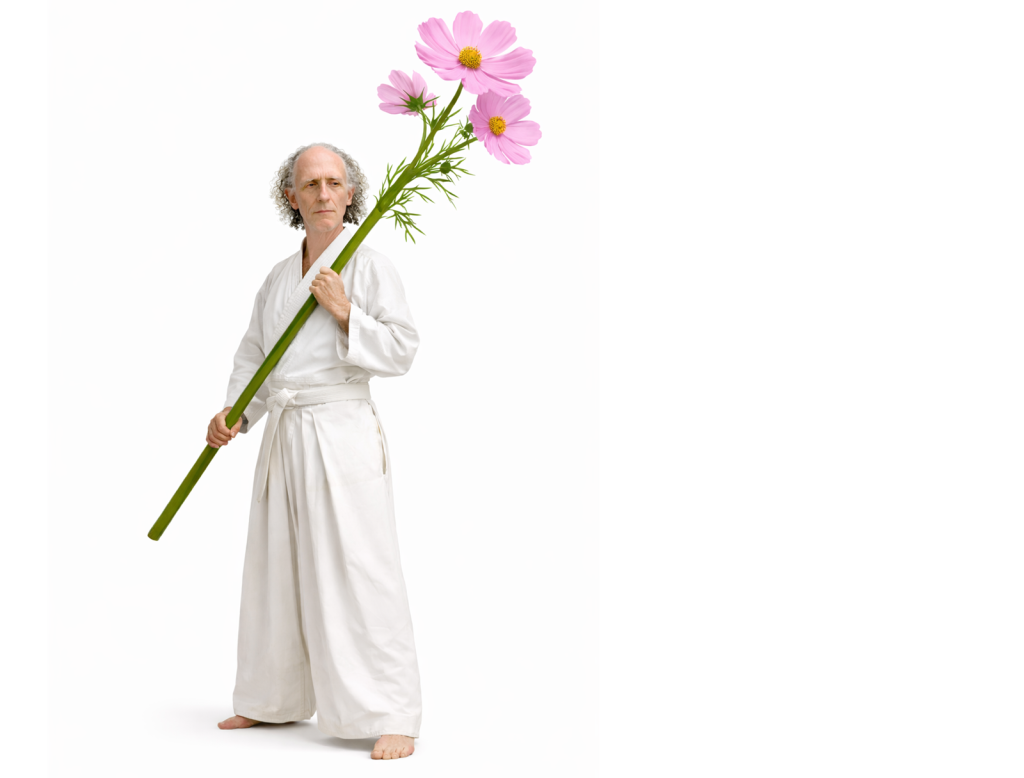
Last weekend it was my pleasure to lead a small bojutsu workshop at Elstree School. I describe it as a pleasure because bojutsu still feels like my first love in shintaido. The first time I picked up a bō staff, I suddenly realised what shintaido was really all about.
“Ah, this is what it means to push out!” I thought to myself.
“This is what tenso means!” as I looked along the full length of staff longer than I reaching far up into the heavens.
Ever since then, bojutsu always manages to put a smile on my face.
Developing a new relationship with bojutsu
One of the things we teach new students is the importance of developing a relationship with their bō. Ideally, it should feel so familiar that it begins to feel like an extension of their own body. At the start of a shintaido journey, this is really good advice, as it enables students to develop and grow their own technique without worrying about differences in weight and length.
However, over many years I realised that bojutsu as a system isn’t really designed with this in mind. Unlike kenjutsu (in which it’s important to have a sword suited to your height and natural strength) bojutsu is far more relaxed in outlook. You can really use any kind of stick to practice bojutsu. The curriculum even seems designed with this in mind: that in a moment of danger you should be able pick up whatever comes to hand and defend yourself with it. Whether short or long, heavy or lightweight, with or without some kind of implement at one end — as long you can pick it up and perform mochikae (changing hands) with it, then you can practice bojutsu with it.
So if you’re one of those who has an old, precious bō, purchased long ago, but which you hardly ever use, don’t feel bad. Perhaps that staff was never for you, or perhaps you outgrew it years ago. The good news is that you can revive your bojutsu skills with whatever comes to hand. Go out and find something more suitable!
Bojutsu Workhop: Sunday 24th May 2026
Sadly, the workshop was not as well attended as I hoped. So for those who were there, as well as those who weren’t, here is a summary of what we practiced.
Warming up with many bō
We started the morning doing a long warm up which included a lot of mochikae. I brought with me a variety of different staves: bō, jō and naginata, for us to play with, so passed these around as we did mochikae. The aim was to get people used to the idea of “changing the staff”, encouraging them to feel the different weight, length and balance of each. I also included a number of simple kihon exercises into the warmup routine.
Freehand receiving a jodan bojutsu attack.
After the warmup we spent some time practicing jodan kihon, both uchi komi and uchi harai. Then we practiced these in kumite, with one person using a bō and the other just using musubi-dachi stepping. At first the receiving partner simply stepped back, saga-irimi, as if offering their partner a target to practice jodan attacks. Then me moved to stepping forward, mae-irimi. I did this using a simple three-step kumite: three jodan attacks.
- Right hand attack — step back, saga irimi
- Left hand attack — step back, saga irimi
- Right-hand attack — step forward, mae irimi
The idea was to use the first two steps to observe speed and rhythm, and the third to step in, inside your partner’s space.
At first we did this just with koshi movement (ie: with stepping). Next we moved to taking hold of our partner’s bō. The idea was to take hold of the bō using a right-hand grip (assuming a right-hand attack) as if going to use the bō yourself. As they did so I encouraged people to think (or even say):
“This is my bō now!”
At the end of the morning I spent some time receiving jodan attacks myself, and showing a little of what one can do having taken hold of your partner’s bō in this way.
Receiving tsuki attacks.
We began the afternoon by doing some free bō tsuki (slowly, around the space) to warm up again, before moving to a variety of tsuki and kohan kihon combinations.
We then repeated the morning’s practice, but this time using freehand irimi (both inside and out) against chudan tsuki with a bō, focussing on koshi movement. We used the same three-step kumite, but this time using three bō chudan morote tsuki attacks, all on the same side. For the first two attacks we offered our partner one side of our body (stepping forward slightly) before stepping back out of reach using saga-irimi. On the third attack we used the same movement to step in. I encouraged people not to worry too much about which foot they were stepping with, as mae irimi works either inside or outside.
Once we got the hang of this we again moved to taking hold of our partner’s bō.
“This is my bō now”.
Kazeno Kata, 風の型
Finally, as we needed a change of pace in the gathering afternoon heat in the hall, we moved to practicing Kazeno kata, which we did quite thoroughly. We first went through the 10 steps of the kata and then practiced a more fluid delivery, both right and left side. I explained the origin of a number of the moves (for instance the famous “sand flick”) and the differing rhythms in the counting.
Later on, I also demonstrated Karei no kon (Spirit of the Flower), my favourite bojutsu kata. I didn’t teach it (it would take a week) but I felt the kata had infused much of the day with its subtle inspiration.

Teaching bojutsu online
This video comes from the series of monthly bojutsu classes I’ve been leading for the last couple of years. Rather than record each keiko (which, however wonderful the class, would make for a long and boring video) my approach has been to say goodbye to my students at the end, and then to immediately record a short 5-minute summary of what we just did. These videos have now become quite an archive and cover the entire kyu-level bojutsu curriculum.
If you would like access to the archive just follow my YouTube channel.
Better still, if you would like to join the bojtsu class please let me know. It takes place on the first Monday morning each month (well, usually…). Having studied all the bojutsu kata and kihon I can think of we are now about to move to the jojutsu kata and kihon embedded in the shintaido bojutsu curriculum. If you are interested in this now is a good time to join the class.